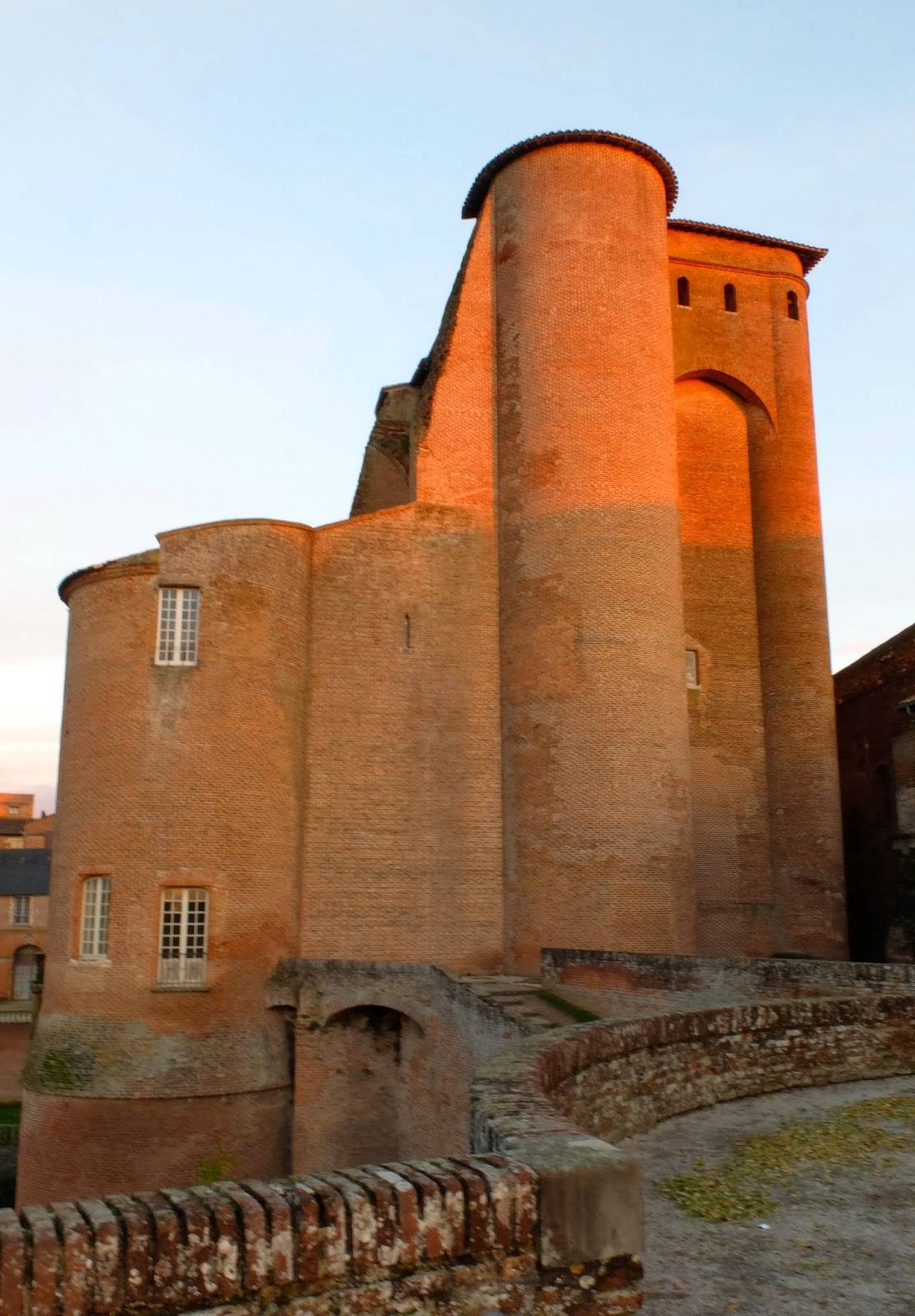
When we filed our previous dispatch, we were leaving chilly
southwest France for sunny Provence.
That would be our final landing spot before meeting up with our three children
for the French holidays.
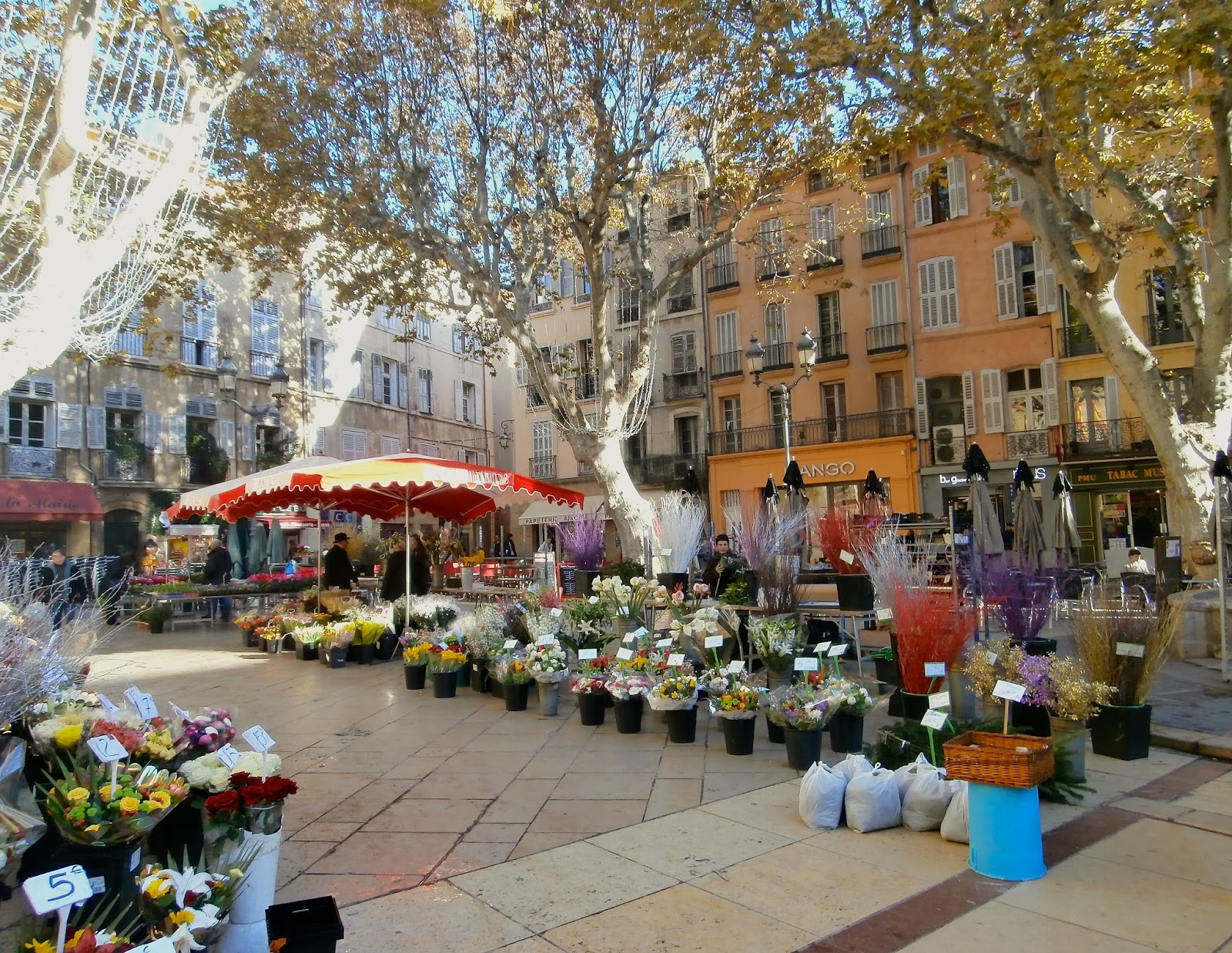 |
| Aix-en-Provence: Flower market in City Hall Square. |
Before going to Provence, though, we briefly visited two
cities on the Mediterranean coast.
MONTPELLIER AND
MARSEILLE
Traveling by train from the old walled city of Carcassonne,
we arrived in Montpellier on a
bright late-November day that was a welcome harbinger of things to come. The city was a port in the Middle Ages, but
its harbor silted up in the 16th century.
Nonetheless, Montpellier’s proximity to the sea and nice climate attract
many visitors. The city has beautiful
parks and monuments, a lovely old quarter of narrow, shop-lined streets, and
one of southern France’s best art museums, the Musée Fabre. A seat of learning since the 13th century,
Montpellier has a large student population that also contributes to its lively
feel.
We planned to find a hotel room for our two-night stay, but
to our surprise every affordable room in Montpellier appeared to be
booked. (We later learned that the city
was hosting a convention of vintners.) Resourceful
Becky found us a rather quirky rental apartment that was satisfactory for our
short visit. As usual, we packed a lot
of walking and sightseeing into a day and a half.
 |
| Montpellier's Place de la Comédie. |
 |
| A street in Montpellier's Old Quarter. |
 |
| La Place Royale du Peyrou, Montpellier |
We continued on to Marseille,
France’s second largest city and a major Mediterranean port. (France’s national anthem, “La Marseillaise,”
is so named because revolutionary militiamen from Marseille brought the song to
Paris in the early days of the French Revolution.) We thought twice about visiting Marseille, as
it has long had a reputation of being a mean-streets city of wenching sailors, drug
crime, labor strife, graft, and unchecked illegal immigration from North Africa
and the Middle East. We decided to check
it out, though, for two reasons: (1) The city is said to be making rapid
strides in renewing its image; and (2) the European Union designated the
Marseille region, including southern Provence, a “European Capital of Culture”
for 2013, and throughout the year Marseille had hosted special events and
exhibitions. Many of these had closed in
September with the end of the tourist season, but some were still open. (The European Capital of Culture initiative has,
since 1985, contributed to upgrading and attracting tourists to more than 50 European
cities, and there is strong competition to earn the EU’s coveted designation.)
As in Montpellier, we’d allotted only a day and a half to
seeing Marseille, so we tried to make the most of the limited time. We’d booked a room in a hotel just two blocks
from the Vieux Port, the heart of the tourist area, which put us within walking
distance of most of the sights we wanted to see. (The Vieux Port is the sheltered harbor where
Phoenician sailors first landed about 600 B.C., and for centuries it was the
city’s port. Today, however, it is used
only for pleasure craft and tourist boats, as the large berths for cargo and
cruise ships are located up the coast.)
 |
| The Vieux Port in Marseille. |
Among the highlights of our time in the city were touring the
fine Museum of the History of Marseille, with an adjoining garden containing
ruins of the early Greek settlement, and visiting the church of
Notre-Dame de la Garde, perched on a hilltop with a panoramic view of the city,
the harbor and the sea. Also special was
the new Museum of Civilizations of Europe and the Mediterranean, housed in a
dazzling glass-and-steel structure that was completed in time for the year-long
“Capital of Culture” fête.
 |
| The Church of Notre-Dame de la Garde on a hill overlooking Marseille. |
 |
| View of Marseille and its modern port from Notre-Dame de la Garde. |
 |
| The brand new Museum of Civilizations of Europe and the Mediterranean. |
Not least of our Marseille highlights was a three-way Skype
call with our children on Thanksgiving Day.
AIX-EN-PROVENCE
Though it’s only a short distance north of Marseille, Aix-en-Provence (or just Aix,
pronounced Ex) is as serene as the
bustling port city is hectic. The
historic central part of the city is neatly divided into two sections by the
Cours Mirabeau, a wide avenue lined on both sides by stately plane trees. (The Comte de Mirabeau, 1749-1791, represented
Aix in the Estates General at the outset of the French Revolution. A writer, politician and diplomat, he was one
of the intellectual leaders of the Revolution in the early years, before the
guillotine began its grisly work.
Mirabeau was one of the few prominent revolutionaries who died in bed of
natural causes, and whose reputation survived the Terror.) North of the Cours Mirabeau is the old quarter,
with narrow winding streets and shaded squares.
Below the Cours is the newer Mazarin district, a primarily residential
area that was laid out in the 17th and 18th centuries in a tidy Enlightenment grid.
 |
| The old Clock Tower in the City Hall Square, near our apartment in Aix. |
For our three-week stay in Aix, we rented a second-floor
apartment on the Rue Gaspard de Saporta in the old quarter. It had a sizable living space and a kitchen
on the first level, and in a loft reached by a circular metal stairway were a
bedroom and another sleeping alcove where our daughter Sarah would bunk when
she joined us later. The location was
convenient for exploring the town.
After more than four months of being constantly on the go,
we allowed ourselves to slow down in Aix.
We visited museums, churches, and other points of interest, but we also
spent relaxing days just meandering through the pretty streets, browsing in
shops, and taking in the many outdoor markets to be found in squares around the
old quarter. For most of our time in
Aix, the weather was ideal, with one sunny, mild day following another.
Although the French don’t go in for Christmas decorations
with the zeal of Americans, there were many reminders of approaching Noel,
lending additional cheer to Aix’s natural charm. As in many French cities, Christmas-market
booths lined one side of the Cours Mirabeau, attracting large crowds,
especially in the evenings.
 |
| The Cours Mirabeau decked out for the holidays (Christmas market on the left). |
 |
| A street performer with her dancing marionettes. |
Aix’s most famous son was the painter Paul Cézanne (1839-1906),
who was born in the city and lived in or near it most of his life. We visited his atelier (studio), which has been preserved just as the painter left
it, and we also hiked up to a small hillside park that marks the spot from
which Cézanne made dozens of paintings of his favorite subject, Mont
Sainte-Victoire, which dominates the horizon east of Aix.
 |
| Statue of Paul Cézanne, Aix's favorite son. |
 |
| Mont Ste.-Victoire from Cézanne's favorite painting site. |
Without a car, we were limited in our ability to explore
other parts of Provence, such as the hilltop villages made famous by the writer
Peter Mayle, which are better seen in the summer anyway. But we took two bus day trips: The first was to Arles, site of some of the
best-preserved Gallo-Roman ruins in southern France.
 |
| Roman Amphitheater in Arles, built around 90 A.D. for up to 20,000 spectators. |
 |
| The Roman Theater in Arles built in the first century B.C. |
Our second excursion was to Avignon, where we saw, but did not dance
upon, the bridge made famous by a children’s song (Sur le Pont/d’Avignon,/on y danse,/on y danse …), and we visited
the vast Palais des Papes (Popes’ Palace), where breakaway Catholics in the
14th century established a rival papacy to the Holy See in Rome (Rome won).
 |
| The Pont d'Avignon, half washed away in the 17th century (after more than 300 years, wouldn't you think...?). |
 |
| Throughout the 14th century, popes in Avignon's Palais des Papes defied Rome. |
Other Aix highlights:
We attended an English-language Christmas sing in St.-Sauveur
Cathedral, whose nave was filled with several hundred American and British
carolers and, as evidenced by a show of hands, a surprisingly large number of
French people as well.
 |
| The crowd assembling for an English-language Christmas sing in Aix's cathedral. |
We watched a holiday défilé
(parade) of musicians, dancers and other performers in traditional dress from
around the region, including an Italian troupe of acrobatic flag-jugglers
(don’t try that at home).
 |
| A troupe of dancers in the holiday parade. |
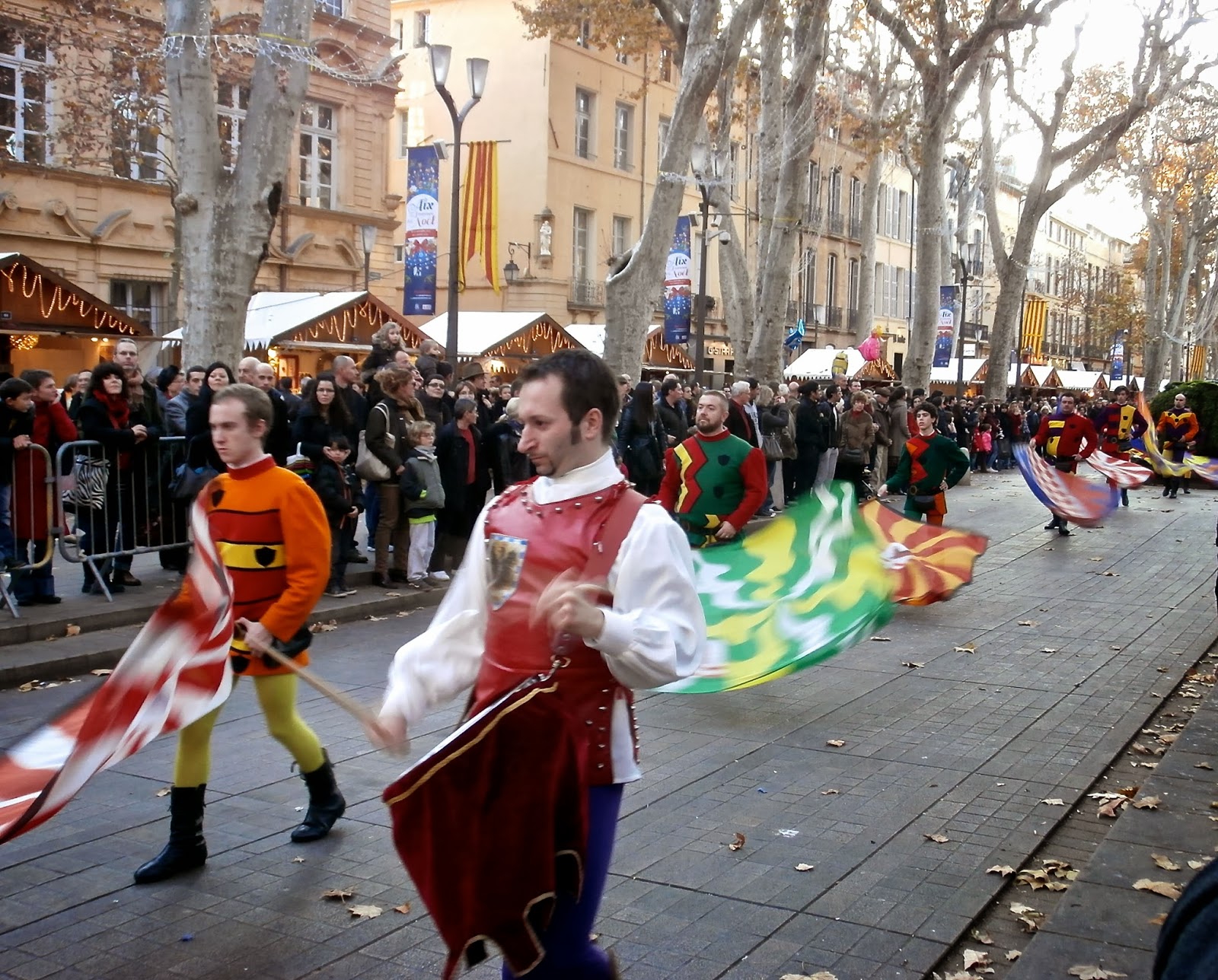 |
| The Italian flag jugglers before their flags went airborne. |
Our daughter Sarah joined us for our last four days in
Provence, including our excursion to Avignon.
OUR HOLIDAY REUNION
From the end of September, when we made the decision to stay
in France through the end of the year, we’d been making plans to get our three
children over to join us for the Christmas holidays. We decided to spend Christmas in Lyon, so we
could introduce the kids to the city where our adventure had started, and then
go to Paris for a final fling. As with
all things that are long in the planning and filled with anticipation, it was
hard to believe when the day finally arrived.
But on December 22nd Becky, Sarah and I greeted Lisa and Garner at the
train station in Lyon when they arrived from Charles de Gaulle Airport in Paris. Hugs all around.
 |
| Lisa, Garner and Sarah in the Luxembourg Garden, Paris. |
The biggest highlight of the next 10 days was just being
together. But a few memorable events are
worth noting:
At a Lyon restaurant in a former train station, we were
joined by our friends Jérôme and Laure and their son, Charles, for lunch in
thanks for our delightful meal at their home in August.
We showed the kids some of our favorite Lyon sights,
including a few of the large wall murals, the Gallo-Roman ruins, and Vieux
Lyon.
On Christmas Day, we enjoyed Becky’s rendition of a
traditional French four-course meal.
After dinner at a Paris bistro, we walked the length of the
Champ de Mars, watching the brilliantly lit Eiffel Tower draw closer and closer,
until we stood directly beneath its graceful immensity.
 |
| The "fam" in a Paris bistro, snapped by a friendly server. |
 |
| Happy memories! |
On New Year’s Eve we attended an orchestra and choir concert
(Beethoven and Mozart) in the venerable St.-Sulpice Church in Paris’s Latin
Quarter; if the acoustics in the vast stone edifice weren’t ideal, the music nonetheless
was majestic, and we agreed it was a fitting way to end 2013.
BONNE NOUVELLE ANNÉE
On New Year’s Day at 1:20 p.m. our Icelandair flight lifted
off from French soil. Our French leave
was over. We were headed home.
To those readers who have patiently followed our trek, we
extend our thanks and our best wishes for a very happy 2014. Or, as we heard countless times over the
past five months: Merci (Thank you). Au revoir (Goodbye). Bonne
journée (Have a good day).
To which we add: A
bientôt! We hope to see you soon!